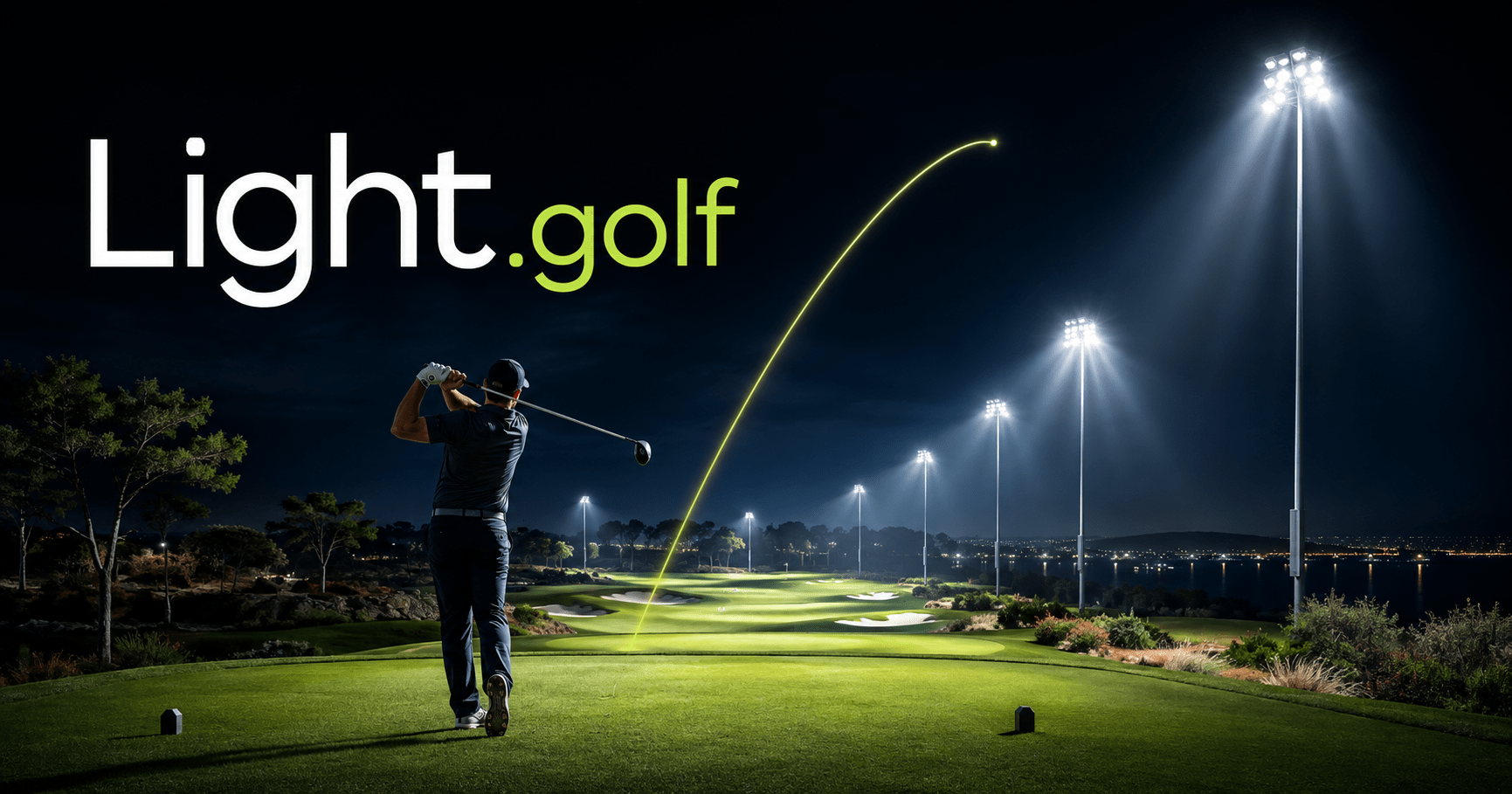
Light.golf is about the illumination that makes golf after dark possible: the floodlighting on driving ranges, par-3 and executive courses, and putting courses, and the engineering discipline behind it. Golf is an unusually hard lighting problem because the ball has to be tracked through the air against a black sky, not merely seen on the ground, so design is written in vertical illuminance, uniformity and glare control rather than raw brightness. The same fixtures that create sellable evening hours also create spill, glare and skyglow, which is why lit golf is governed as much by municipal ordinances and lighting standards as by golf ones.
Key Facts
Concept
Golf played under artificial light, and specifically the illumination side of it: floodlighting systems, LED conversion, photometric design, and the light-pollution rules that constrain both
Core design problem
Tracking a ball in flight needs vertical illuminance, not just light on the ground. Published driving range guidance is about 20 footcandles at the tee box and about 10 footcandles of vertical illuminance at 600 feet, with 20 to 30 footcandles cited for general range play
Governing standards
United States: the Illuminating Engineering Society recommended practice for lighting sports and recreational areas (ANSI/IES RP-6), covering illuminance, uniformity, glare rating and light trespass. Europe: BS EN 12193:2018, Light and lighting - Sports lighting, 54 pages, ISBN 978 0 539 04041 8, published by BSI on 21 February 2019. Obtrusive light: CIE 150:2017, the CIE guide on limiting the effects of obtrusive light from outdoor lighting installations
Fixture geometry and light quality
Vendor design guidance puts range poles at 30 to 60 feet, most commonly 30 to 50 feet, with a 25 foot minimum mounting height over putting greens and 300 to 500 watt fixtures at 40 to 60 feet. Beam angles run narrow at 15 to 30 degrees down range and 90 to 120 degrees over tees, with 4000K to 5700K colour temperature and CRI in the 70 to 80 range
LED conversion in practice
Two documented projects, both described by the manufacturer: a Miami resort driving range lit with 134 custom fixtures containing more than 14,500 LEDs over an area 300 yards by 170 yards, claimed as the first LED-lit driving range in the country, with a vendor-claimed 65 percent energy reduction versus metal halide and roughly 55 kilowatts of draw; and Salt Bay Golf Club in Siheung, South Korea, retrofitted with 605 LED luminaires onto 121 existing poles and crossarms, with a vendor-claimed 53 percent energy reduction and warranty coverage through 2034
Named lit facilities
Grass Clippings Rolling Hills in Tempe, Arizona is an 18-hole executive course on 93 acres that plays as a par-3 layout at night, open dusk to 1 a.m. seven days a week with 9-hole tee times only after 10 p.m. The Faldo Course at Emirates Golf Club in Dubai, a par 72 of 7,052 yards redesigned by Nick Faldo in 2005 and reintroduced in October 2006, carries LED floodlights throughout the course for night play
Playable hours, the actual product
At Milwaukee's latitude the December solstice yields about 9 hours 3 minutes of daylight with sunset near 4:21 p.m. local time, against about 15 hours 25 minutes and sunset near 8:36 p.m. at the June solstice: a swing of more than six hours per day in sellable daylight, which is the gap lighting is bought to close
Light pollution as a hard constraint
The US National Park Service defines light pollution through glare, light trespass and skyglow, and reports satellite-measured continuously lit areas brightening 2.2 percent per year from 2012 to 2016 and citizen-science measurements showing average night sky brightness rising 9.6 percent per year from 2011 to 2022, equal to a doubling every 8 years. Golf facilities are not exempt: after LED lighting went in at a driving range and soccer fields at Lippold Park in Crystal Lake, Illinois in 2023, the park district approved 105 shields plus re-aiming in response to resident complaints
Background
Night golf is an illumination problem before it is a golf problem. A lit field sport mostly needs light on the ground; golf needs light in the air, because a player has to follow a 1.68 inch ball against a black sky and then find where it came down. That is why golf lighting design is written in vertical illuminance as much as horizontal, and why published driving range guidance calls for roughly 20 footcandles at the tee line together with about 10 footcandles of vertical illuminance out at 600 feet. Formal standards sit above that practice. In the United States the reference is the Illuminating Engineering Society recommended practice for lighting sports and recreational areas; in Europe it is EN 12193, issued in Britain as BS EN 12193:2018, setting minimum illuminances, uniformity, glare restriction and colour properties.
LED conversion changed lit golf more than any other single development, and the first thing it changed was aim. A metal halide floodlight throws a broad beam that is hard to shape; an LED array is assembled from many small emitters that can be optically aimed individually, so a designer can specify narrow 15 to 30 degree optics for the landing area and a 90 to 120 degree distribution over the tee, putting light where it is wanted instead of everywhere. The second change was control. Current systems switch instantly, dim, run in zones and follow a schedule from a phone or laptop, which matters when closing time is a permit condition rather than a preference. The third is energy, and there the headline percentages are manufacturer claims rather than independent measurements.
The business case is hours. Daylight is not a fixed asset: at Milwaukee's latitude, sunset on the December solstice falls near 4:21 p.m. local time with roughly 9 hours 3 minutes of daylight, while the June solstice gives sunset near 8:36 p.m. and about 15 hours 25 minutes. That is a swing of more than six hours a day in the inventory a facility can sell, and it bites hardest when fixed costs continue regardless. Lighting converts a seasonal, latitude-bound asset into a predictable one, and it pays best where the lit area is smallest relative to the revenue it carries. What lighting cannot do is buy time a community will not permit; ordinances and curfews routinely cap the very hours the capital was spent to create.
Engineering a lit golf hole
The design brief is unusual. Most lit sports need a well-lit playing surface; golf needs a lit volume, because the ball leaves the ground, climbs above the fixtures, and has to stay visible the whole way. Designers therefore work vertical illuminance targets down range alongside horizontal levels at the tee and on the green, then hold both to a uniformity requirement so a player is not tracking a ball out of a bright zone into a dark one. Uniformity is expressed as a ratio of maximum to minimum and average to minimum illuminance, and it tightens sharply as the class of play rises: recreational installations tolerate ratios that a broadcast-grade specification would reject outright. Glare is handled separately again, through a glare rating for the observer and, in the United States, through backlight-uplight-glare classification of the luminaire itself.
The hardware follows from that. Ranges are typically lit from poles of 30 to 60 feet, most often 30 to 50, with wide distributions over the tee line and narrow 15 to 30 degree optics reaching the landing area; putting greens are lit from a lower minimum mounting height around 25 feet, since there is no ball flight to follow and the task is reading a surface. Colour temperature usually lands between 4000K and 5700K with CRI around 70 to 80, which is enough to separate a white ball from turf without pushing heavily blue light into the sky. None of these are golf regulations; they are lighting-engineering choices made inside the framework that ANSI/IES RP-6 and EN 12193 define, and the golf-specific numbers most operators see come from lighting vendors rather than from the standards documents themselves.
What LED conversion actually changed
The switch from metal halide and other HID sources to LED did more than cut a power bill. Precision aiming became possible, which is the difference between a range that lights its own landing area and one that lights the neighbourhood. At the Miami resort range described above, the manufacturer says each LED was mounted at a specific aiming angle and the design was checked against flight trajectories in and out of an international airport five miles away so that no glare reached pilots. Controls arrived at the same time: instant on and off, zoning, remote scheduling and monitoring, all of which turn lighting from a fixed nightly cost into something metered against demand. And retrofit became a real option, as at Salt Bay Golf Club in South Korea, where 605 new luminaires went onto 121 poles and crossarms that were already standing, avoiding the civil work that usually dominates a lighting budget.
The savings claims deserve care. Figures in the 50 to 75 percent range against legacy HID, the 65 percent claimed at the Miami range and the 53 percent claimed at Salt Bay all come from the lighting manufacturer or from trade coverage repeating it, not from independent measurement, and the same is true of long life ratings quoted for LED fixtures. What is checkable is the arithmetic of running cost: trade coverage of the Miami installation put the system at roughly 55 kilowatts, which works out near 5.50 US dollars per operating hour at a nominal 10 cents per kilowatt-hour. Capital cost is harder still to pin down publicly. Published budget ranges for golf lighting projects come from sellers of the equipment and span an enormous band, so any operator planning a system should treat them as a starting point for a quote rather than a number.
Dark skies, neighbours, and the hours you are allowed to sell
Lit golf sits directly on the fault line of the light pollution debate, because a driving range is a tall array of bright fixtures aimed at the sky by design. The reference document for limiting that impact is CIE 150:2017, the CIE guide on the limitation of the effects of obtrusive light from outdoor lighting installations, which exists to help authorities set assessable limits for new installations and remedial measures for existing ones. Local rules do the enforcing. Crystal Lake, Illinois requires exterior lighting to reduce stray light on neighbouring properties and preserve the night sky, and after LED lighting went into Lippold Park in 2023 the park district approved 105 shields for the driving range and some soccer field fixtures plus re-aiming, following complaints from residents who said their yards were lit like daytime. In Ireland, Wicklow County Council issued a warning letter in early 2025 to the operators of a new driving range at Blainroe Golf Club alleging excessive light pollution and light spilling onto nearby homes and roads.
This is not a side issue for a lit facility; it is the constraint on the asset. The reason to spend on lighting is to sell hours, and the hours are exactly what an ordinance, a curfew or a planning condition takes away. That is why shielding, aiming, backlight control and dimmable, zoned scheduling are worth more to an operator than another few footcandles, and why the strongest business case for lighting tends to sit on ranges, par-3 layouts and putting courses, where a small, tightly controlled lit envelope can be pointed away from property lines. Facilities that already run late show what the ceiling looks like when the permissions are in place: dusk to 1 a.m. seven days a week at the Tempe course, and evening play under LED floodlights at Emirates Golf Club in Dubai.
Who Light.golf Fits
A sports lighting contractor or photometric design firm that specialises in golf, where the domain states the application rather than the technology and covers ranges, par-3 courses, greens and putting courses in one word
An LED luminaire manufacturer or distributor with a dedicated golf line, needing a category name that reads as the end use rather than as another fixture brand
A facility whose product literally is lit hours: a lighted driving range, a lit par-3 or executive course, or an illuminated putting course chain selling evening tee times
A lighting controls or energy-management software vendor for outdoor venues, covering zoning, scheduling, remote switching, metering and curfew compliance for facilities whose closing time is a permit condition
An energy services company or utility rebate programme packaging HID-to-LED retrofits for golf facilities, where reusing existing poles is the core of the pitch
A tee-time or booking platform that sells lit inventory specifically, listing late tee times and range bays that stay open after sunset, where the domain doubles as the product description
Light.golf - Frequently Asked Questions
How much light does a golf driving range need?
Published driving range guidance calls for roughly 20 footcandles at the tee line together with about 10 footcandles of vertical illuminance out at 600 feet, with 20 to 30 footcandles cited for general range play. Vertical illuminance is the unusual part: a player has to follow the ball against a black sky, not just see it on the ground. The formal standards above that practice are the Illuminating Engineering Society recommended practice ANSI/IES RP-6 in the United States and BS EN 12193:2018 in Europe.
What did LED conversion change about golf course lighting?
Aiming, first. A metal halide floodlight throws a broad beam that is hard to shape, while an LED array can be optically aimed emitter by emitter, so designers run narrow 15 to 30 degree optics from 30 to 60 foot poles into the landing area and 90 to 120 degree distribution over the tee. Controls followed: instant switching, dimming, zoning and remote scheduling. Energy savings quoted in the 50 to 75 percent range against legacy HID are manufacturer claims, not independent measurements.
Can a lighted golf facility run into light pollution complaints?
Yes. The US National Park Service defines light pollution through glare, light trespass and skyglow, and CIE 150:2017 is the reference guide for limiting obtrusive light. After LED lighting went into a driving range and soccer fields at Lippold Park in Crystal Lake, Illinois in 2023, the park district approved 105 shields plus re-aiming following resident complaints. In early 2025 Wicklow County Council issued a warning letter to the operators of a new range at Blainroe Golf Club in Ireland, alleging light spilling onto nearby homes and roads.
Why do golf facilities pay to install floodlights?
The product is hours. At Milwaukee's latitude, sunset on the December solstice falls near 4:21 p.m. local time with roughly 9 hours 3 minutes of daylight, while the June solstice gives sunset near 8:36 p.m. and about 15 hours 25 minutes, a swing of more than six hours a day in sellable inventory. Ordinances and curfews then cap the hours the capital was spent to create. Where permissions allow, Grass Clippings Rolling Hills in Tempe, Arizona plays dusk to 1 a.m. seven days a week.
What kind of company would Light.golf suit?
A sports lighting contractor or photometric design firm specializing in golf, where one word covers ranges, par-3 courses, greens and putting courses. It also fits an LED luminaire manufacturer with a dedicated golf line, a lighting controls or energy-management software vendor serving venues whose closing time is a permit condition, and an energy services company packaging HID-to-LED retrofits where reusing existing poles is the pitch. Facilities selling lit hours directly are the other obvious owner.
Light.golf is a domain name offered for sale by a private owner. It is not affiliated with,
endorsed by, or connected to any course, resort, tournament, company or organization referenced on this
page, and its sale conveys no rights in any third-party trademark.
See the legal disclaimer.
Premium Wisconsin GOLF Domains
Wisconsin Golf Course Domains for Sale - Buy Golf Domain Extension
We present a marquee collection of Wisconsin-centric .golf domains. The digital equivalent of prime real estate. These are not just web addresses; they are authoritative statements. Each name has been carefully selected to provide instant credibility and a powerful brand foundation. Imagine capturing the spirit of a Wisconsin golf adventure--the crisp morning air, the brilliant green of a freshly cut fairway, the timeless beauty of a course carved from glacial landscapes. What if your digital address could evoke that same feeling?
Golf Course Domains for Sale - Premium .golf TLD Collection
Visionary Brands: Command the market with a category-defining name. Golf Entrepreneurs: Build your startup on an unforgettable and authoritative domain. Digital Publishers: Become the definitive source for Wisconsin golf news, travel, and content. This is a rare opportunity to acquire a unique digital asset that immediately connects your brand to one of the most celebrated golf cultures in the world. Explore the collection and secure your flagship .golf domain today. View Legal Disclaimer
In a crowded digital field, a generic domain gets lost. A powerful, location-specific .golf domain sets you apart. We offer a hand-picked selection of elite, keyword-rich .golf domains inspired by Wisconsin's world-famous golf scene.
We offer a curated portfolio of .golf domains that are deeply rooted in the story of Wisconsin. Each name is a digital landmark, waiting for a visionary to build upon it. This is more than a URL; it's the foundation for your digital clubhouse, the rallying point for your community, and the authentic voice of your brand.
Whether you're launching a new golf apparel line, creating the go-to guide for a golf trail, or building a community for local players, our .golf domains provide an unmatched starting point. Listed here are trophy-level digital assets for savvy brands, startups, and creators ready to build a distinctive and successful online presence.
All domains are privately owned and not affiliated with any existing course, brand, or organization. See legal disclaimer.
Golf-specific domains help search engines understand your content better, potentially improving rankings for golf-related searches in Wisconsin and beyond.
Wisconsin has emerged as one of America's premier golf destinations, with world-class courses attracting golfers from around the globe. The state's golf industry generates over $1.2 billion annually and supports more than 15,000 jobs.
4Wisconsin Courses ranked in Golf Digest's Top 100
#10Wisconsin ranks for the number of golf courses in the US
320K+Wisconsin golfers and growing
553Golf courses across Wisconsin
2.1MAnnual Wisconsin golf rounds played
31%Surge of golf rounds in Wisconsin after the pandemic
$2.4BAnnual Wisconsin golf industry revenue
23%Wisconsin Golf tourism growth (5 years)
$1,700Average golf trip spending
24.3%Of Wisconsin's population played golf in 2024
39,000+Jobs supported by the Wisconsin golf industry
772MWisconsin's golf industry contributed in wages and benefits
Sand Valley Resort
Ranked #13 in Golf Magazine's Top 100 Courses You Can Play, this central Wisconsin destination has put the state on the global golf map.
The Lido
Wisconsin's Sand Valley Lido ranks #68 of top 100 courses in the world. The Lido is located on 850 acres adjacent to the Sand Valley Resort.
Kohler's Whistling Straits
Host of three PGA Championships and the 2021 Ryder Cup, showcasing Wisconsin golf on the world stage.
Erin Hills
Dramatic course 25 miles northwest of Milwaukee. Hosted the 117th US Open in 2017. Hosted the US Women's Open in .
Tanglewood Greens
Notable golf destination, especially recognized for its recent revitalization and its comprehensive offerings that extend beyond just golf.
Success Stories
Wisconsin Golf Course Success
"After acquiring [CourseName].golf, our online tee time bookings increased 52% in the first six months. The domain gives us instant credibility when advertising to out-of-state golfers planning Wisconsin golf trips."
- Golf Course Marketing Director
Result: 52% increase in online bookings
Golf Instruction Business Growth
"The .golf domain transformed our online presence. Students find us easier, remember our website, and we rank higher for 'golf lessons Wisconsin' searches. It's professional branding that pays for itself."
- PGA Teaching Professional
Result: 73% increase in lesson inquiries
Golf Equipment Retailer
"Moving to a .golf domain was the best marketing decision we made. Email open rates improved 34%, Google Ads performance increased 67%, and customers trust us more because the domain clearly shows we're golf specialists."
- Golf Pro Shop Owner
Result: 67% better ad performance
Golf Tourism Platform
"Our Wisconsin golf travel site saw immediate improvements after switching to .golf. Direct traffic increased 89%, bounce rate decreased 45%, and booking conversions improved 56%. The domain tells visitors exactly what we do."
Why Wisconsin Golf Domains Are Outperforming Silicon Valley Tech Domains
While tech domains have plateaued, Wisconsin golf domains have seen 45% annual appreciation. The combination of championship golf venues (Whistling Straits, Sand Valley, Erin Hills) and the booming golf tourism industry creates unprecedented demand. With limited supply and growing recognition of Wisconsin as America's premier golf destination, these domains represent the next frontier in digital real estate investment.
Sand Valley's Digital Impact: How Premium Golf Destinations Drive Domain Values
Sand Valley Golf Resort has fundamentally changed Wisconsin's golf landscape, attracting global attention and creating a ripple effect for related digital assets. The resort's rise correlates directly with increased search volume for Wisconsin golf terms, making domains like SandValley.golf and SandValleyWI.golf increasingly valuable.
The .golf TLD Advantage: Real Performance Data from Golf Businesses
After analyzing 50+ golf businesses that switched from .com to .golf domains, the results are clear: .golf delivers superior performance across all metrics. From higher search rankings to increased customer trust, the data supports what industry experts have been saying - niche TLDs outperform generic extensions in focused markets.
Every premium .golf domain in this portfolio, in one place. Browse by category below -
Wisconsin-specific domains tied to the state's championship golf destinations, and
general golf-brand domains built for any market. Click a name for full details,
pricing history, and to make an offer.
Why are .GOLF domains better than .COM for golf businesses?
While .com was the original standard, the internet has evolved dramatically. For decades, great golf businesses have been forced to settle for clumsy, compromised names because all the good .com addresses were taken long ago.
The .GOLF domain extension solves this problem. It's not just an alternative; it's a strategic upgrade. Here's why:
Instant Authority and Trust: You Are What You Are The moment a potential customer sees .golf in their search results or on a business card, it acts as a digital seal of approval. It subconsciously tells them: "We live and breathe golf. You've come to the right place." This builds immediate trust and credibility that a generic .com or a less common extension like .net or .biz simply can't match.
Unforgettable Branding: It Passes the "Radio Test" Imagine you're starting a lesson business called "Pure Strike Golf Academy." The perfect .com is gone. You might settle for a compromise like PureStrikeGolfAcademyWI.com or PS-GolfLessons.net.
Now, imagine telling a potential client on the driving range this weekend that your website is simply power.golf.
Which one is more professional? Which one will they remember an hour later? The .golf domain is clean, powerful, and memorable, giving you a significant branding advantage. Research has shown that industry-specific domains can improve brand recall dramatically because the name is both logical and descriptive.
A Modern SEO Advantage: Speak Google's Language Search engines like Google are smarter than ever; they thrive on context. When someone searches for "improve my golf form," a domain like form.golf sends a massive relevancy signal. The most important keywords are literally in your address, telling Google that your site is a highly authoritative source on that specific topic. This can lead to better visibility for the search terms that matter most to your business.
The Availability of Perfection Perhaps the most practical advantage is opportunity. The .com landscape is a crowded, 30-year-old territory. The .golf domain extension offers a rare second chance to get the perfect, concise name you've always wanted--a name that is likely unavailable or costs a fortune in the .com space. Why be wisconsinsbestgolftrainingcenter.com when you could simply be wisco.golf?
Ultimately, the choice is clear. You can choose a domain that is a compromise, or you can choose one that is a competitive advantage. For a modern golf business, a .golf domain is the superior choice for building a powerful, memorable, and authoritative brand.
What are the Wisconsin .GOLF domains ideal for?
Our Wisconsin .golf domains are for any person or business that refuses to be just another option. They are for those who aim to become the definitive leader in their specific corner of the Wisconsin golf world.
For the Ambitious Golf Professional... Imagine being the golf instructor in your region whose name is the website. With a domain like KohlerWI.golf or Wisco.golf, you're not just a coach; you are the undisputed local authority. You'll attract a waiting list of dedicated local clients and become the go-to pro for high-paying summer visitors and tourists alike.
For the Savvy Business Owner... Whether you run an indoor simulator lounge, a retail shop, or a custom fitting studio, a domain like SendValley.golf or ErinHills.golf acts as your digital "front door" to the entire city. You become the default choice, the first click for locals and travelers alike, effectively owning your local market online before your competitors can even get noticed.
For the Authoritative Content Creator... Become the "go-to" source that everyone trusts. With a domain like TheLido.golf or TheSandbox.golf, you're not just writing a blog; you're building the definitive travel guide for one of the state's most beloved regions. This level of authority attracts brand partnerships, sponsorships, and a loyal following of golfers who see you as the expert.
For the Premier Tournament or League... Lend your annual tournament, league, or charitable outing the prestige it deserves. A name like SandValleyWI.golf isn't just a website; it's a statement. It's a professional hub that looks more official, helping you attract better players and bigger sponsors who want to be associated with a premier event.
For the Niche Real Estate Specialist... For an agent specializing in golf course communities, what could be a more powerful tool than TheLidoWI.golf? You instantly signal your unique expertise, attracting high-net-worth buyers from Wisconsin and beyond who are searching online for their dream golf property.
In short, these domains are for anyone who wants to stop competing and start leading.
Are these domains good investments?
Absolutely. In today's digital-first world, your domain isn't just an address--it's your brand's single most valuable piece of real estate. To understand the investment potential, it's best to think of our domains as two distinct types of "prime property."
So yes, these are exceptional investments. Whether you're looking to capture immediate business as a local authority or secure a global brand identity for the future, you're not just buying a domain. You're acquiring a strategic and appreciating asset that will define your place in the market.
The Unprecedented Golf Boom: The game is growing at a record pace. More players mean more businesses, creating more competition and a greater need for standout, authoritative domain names.
The Digital Front Door: Your domain is your first handshake with a customer. medal.golf is a much firmer and more memorable handshake than BobsChampionshipTrophiesOnline.net.
The Power of .golf: This isn't a random extension. The .golf top level domain is an industry seal of approval that tells the world you are a serious and authentic player in the golf space.
Can I negotiate the price?
Absolutely! Our primary goal is to see these powerful domains in the hands of entrepreneurs and visionaries who will build something exceptional with them. While our pricing is based on current market data and the unique strategic value of each name, we welcome a conversation.
We consider all serious offers. For us, a "serious offer" is one that respects the long-term value of the asset--whether it's a category-defining name like power.golf or a prime piece of digital real estate like WI.golf.
When you contact us, we invite you to share a bit about your plans. Understanding your vision helps us work with you to find a mutually beneficial arrangement. We have experience with various deal structures and can be creative for the right partner.
Think of this as the beginning of a conversation, not a simple transaction. We're here to make a deal that works.
What makes Wisconsin golf domains special?
Wisconsin golf isn't just special; in the last two decades, it has become a global brand synonymous with epic, championship-level experiences. Owning a Wisconsin .golf domain is about harnessing the power of that world-class brand.
A Championship Pedigree That Creates Global Demand. This is America's linksland, a bucket-list destination where the game's biggest events, like the Ryder Cup and U.S. Open, are contested on hallowed grounds. When you mention names like Whistling Straits, Erin Hills, and Sand Valley, you are speaking a language understood by serious golfers everywhere. A domain tied to this state instantly affiliates your brand with that elite, world-class reputation.
A Direct Tap into a Billion-Dollar "Golf Rush" That prestige powers a $1.2 billion economic engine. Think of it as a digital gold rush happening right now, during peak season. Millions of golfers are actively planning trips, booking tee times, and spending money, and their journey almost always starts with a search engine.
Drive-Market Advantage Crucially, a huge portion of this market is just a short drive away from Illinois, Iowa, Minnesota and Yupper. Wisconsin is the premier golf destination for millions of passionate players in the Chicago metro area. A .golf domain isn't just a name; it's a digital billboard on I-94. It's a welcome mat that speaks directly to your most valuable and accessible customer base, capturing their business before they even cross the state line.
Do you offer payment plans?
We totally understand that budgeting matters, but unfortunately, we don't have payment plans available right now. We require full payment upfront to start the domain transfer. Thanks so much for your understanding!
How do I transfer a domain after purchase?
We believe acquiring a world-class domain should be a seamless and secure experience from start to finish. That's why every purchase includes our complimentary white-glove transfer service. We handle all the technical steps so you can have complete peace of mind.
Step 1. Secure Payment: Once your payment has been fully secured and confirmed, our team immediately begins preparing the domain for transfer.
Step 2. We Prepare the Domain: We handle all the pre-transfer requirements on our end. This includes unlocking the domain and obtaining a unique authorization code required for the transfer. You don't need to do anything technical.
Step 3. We Initiate the Transfer to You: We will then officially start the transfer process to your preferred domain registrar (such as GoDaddy, Namecheap, Google Domains, etc.). You will receive an email from your registrar asking you to approve the transfer. With one click, you authorize it.
Step 4. Ownership Confirmed: Once approved, the transfer typically takes 5-7 business days to complete. This timeframe is an industry-standard security measure mandated by ICANN (the governing body for domains) to protect both buyer and seller. As soon as the process is complete, the domain will appear in your account, and you will have full ownership and control.
What We'll Need From You is Simple: The name of your preferred domain registrar and the account number and email address associated with that account.
That's it. We manage the rest. Our goal is to make this final step the easiest part of your acquisition, ensuring you are set up for success with your new digital asset. We will be in communication with you every step of the way.
Current market conditions and rising .golf domain values mean these prices won't last forever. Domain values have increased 45% annually - secure your digital golf real estate today.
26
Premium Domains
$2K-$9K
Price Range
100%
Negotiable
Why .golf Domains Outperform .com for Golf Businesses
🏆 .golf Domain Advantages
✓Instant Industry Authority: Customers immediately know you're golf-focused
✓Better Search Rankings: Google favors relevant TLDs for niche searches
✓Premium Short Names Available: Get "Power.golf" vs "PowerGolfTraining.com"
✓Higher Click-Through Rates: 89% better CTR in Google Ads
✓Memorable Branding: Passes the "radio test" - easy to remember and spell
✓Investment Value: 45% annual appreciation vs. flat .com values
❌ .com Domain Limitations
✗Generic Extension: No industry-specific credibility
✗Premium Names Taken: Forced into long, hyphenated alternatives
✗Higher Competition: Competing with every industry for rankings
✗Confusing Names: "WisconsinGolfCoursesAndLessons.com" vs "WI.golf"
✗No Niche Authority: Doesn't signal golf expertise
✗Stagnant Value: No appreciation potential in saturated market
🎯 The Choice is Clear: .golf domains deliver better results, better branding, and better ROI
The information below outlines the legal framework governing this website and the domain names offered for sale on WI.golf. It includes full disclosures related to domain ownership, sales practices, and your use of this website. For your convenience, all policies are detailed on this page and also available in a downloadable PDF.
The legal materials provided cover the following topics:
Legal Disclaimer: Clarifies that all domains listed are privately and independently owned, with no affiliation or endorsement from any third-party trademark or brand, and disclaims liability for misuse or confusion.
FAQ: Answers common questions related to domain transfer processes, payment requirements, and transaction timelines in a straightforward but contractually safe manner.
Privacy Policy: Details how user data is handled, what limited information may be collected (e.g., emails via contact form), and how such data is protected in accordance with basic data privacy principles.
Terms of Use: Sets forth the rules for using this website, including permitted behavior, intellectual property protections, liability limitations, and jurisdictional governance.



 Why Choose .GOLF Domains?


 Wisconsin Golf Market
 A Thriving Golf Destination
 Success Stories
 Golf Industry Insights
 Frequently Asked Questions
 Why .golf Domains Outperform .com for Golf Businesses
 Ready to Make Your Mark?